
On The Liberal Arts
An Overview
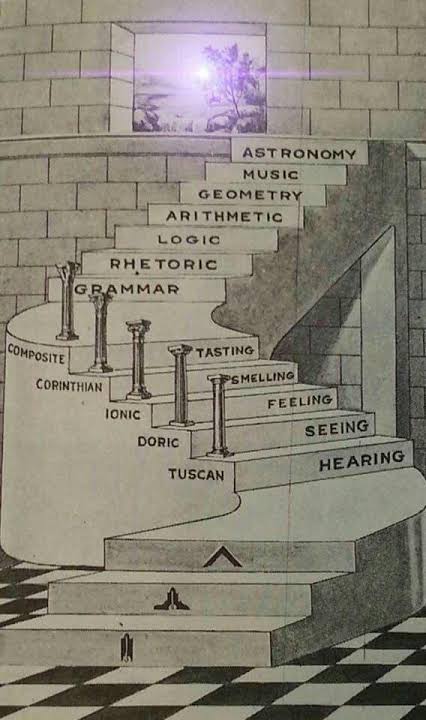
The image above depicts the steps to which the liberal arts ATTAIN something – that ATTAINMENT being BEAUTY.
Beauty is considered the highest form of victory and the ultimate goal for any Arts Student.
Beauty is both in their inventions, their interpretations, responses to the world – AND in their PERCEPTION of the world! So much beauty in the world! Joy! Love! Attain!
On Rhetoric
Rhetoric is one of the most overlooked for artists and common people. A word, phrase, or reference, neednt be changed or elaborated on the be understood. When the student understand this, a seemingly empty or ambiguous statement becomes very clear. In fact, there are many idioms that make no sense when you pull them aside, until you realize society already uses this type of rhetoric on a daily basis without knowing it. That type of rhetoric is essentially that the intention of a meaning relies heavily on context and suggested subtext. The word Love, for example, is one of the clearest uses of this. People argue its meaning. They argue if its even real. I’m here to tell you, of course its real! So is magic! Words like Love have many meanings – and their suggestions rely so very much on the surrounding context to get that meaning filled.
Some people however, are aimless, careless, reckless even, in their use of rhetoric in this way. A sharp observing can quickly see their mediocrity! Or perhaps – they can understand as perfectly as they can despite a speaker’s limited vocabulary!
Another example we all should know of this type of rhetoric is the rhetorical question. It is assumed it is to not be answered. [Literally – or at all! – Or another way.] This, along with sarcasm similarly, is very commonplace, easily communciated, and idiomatic for many. Most know when there is a rhetorical question, or how to place one. (In common speech and then for the artist in story-building/etc.)
Other uses or definitions of rhetoric include accents, select uses of idioms, language choices. These are the more studied versions of it.
The student will of course, cultivate ALL OF THE ABOVE heavily in their art-inventive-mind.
Inflection is of course VERY close to the first definition I gave of rhetoric. (Of which the reader should be familiar with from my other pages.)
Grammar works well with the inflectional side of rhetoric, and its rules really must be used in the understanding of rhetoric for either to be fully perceived or used.
I will edit this post and provide more concrete examples.
~~~~~~~~~~~~~~~~~~~~~~~~~~~~~~~~~~~~~~~~~~~~~~~~~~~~~~~~~~~~~~
This is a preliminary preview. This page will be expanded on. I will break it down into basic terms that are easy to understand.